Pulsed-wave, continuous-wave and colour Doppler: aliasing and uses
13-year-old small-breed dog with myxomatous mitral valve disease. Colour Doppler shows a mosaic regurgitant jet into the left atrium. You want to measure its peak velocity, but with pulsed-wave Doppler the spectrum is cut off at the top and wraps around to the other side of the baseline:
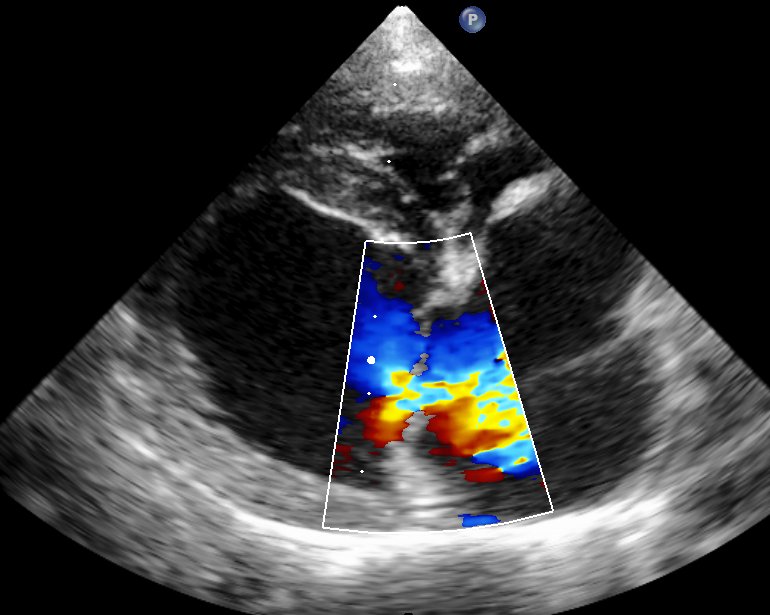 zoom_inEnlarge
Which statement is correct?
chevron_right Show answer and explanation
A. Colour Doppler is the best mode for measuring peak velocity accurately
Colour Doppler shows direction and mean velocity colour-coded, and is also subject to aliasing (mosaic pattern). It is useful for locating turbulent flow, not for measuring peak velocities.
B. The transducer frequency should be increased to avoid aliasing
For the same velocity, a higher frequency produces a greater Doppler shift and makes aliasing more likely. A lower frequency, less depth or shifting the baseline help.
C. Continuous-wave Doppler should be used: it has no Nyquist limit and measures high velocities, although it cannot locate the exact depth
Correct. Pulsed-wave Doppler samples at a specific point, but its maximum measurable velocity is limited by the pulse repetition frequency (Nyquist limit). Continuous-wave transmits and receives continuously: it measures any velocity, though along the whole line.
D. Aliasing indicates normal, laminar flow
Aliasing occurs when velocity exceeds the Nyquist limit. A mitral regurgitant jet reaches about 5–6 m/s, far above the pulsed-wave limit; the colour Doppler mosaic is also aliasing from fast, turbulent flow.
lightbulb Key takeaway
Pulsed-wave = localises the point but has a velocity limit; continuous-wave = measures high velocities without localising; colour = map of direction and turbulence. Align the beam with flow (angle < 20°): too wide an angle underestimates velocity and gradient (simplified Bernoulli equation, 4v²).
Test yourself with 10 random questions
Diagnostic imaging · 200 questions, a different test every time
Related questions
Updated: October 31, 2026 · Educational content for veterinary professionals. It does not replace current clinical guidelines or the judgement of the attending veterinarian.