Thickened colon in a young cat: ultrasound interpretation
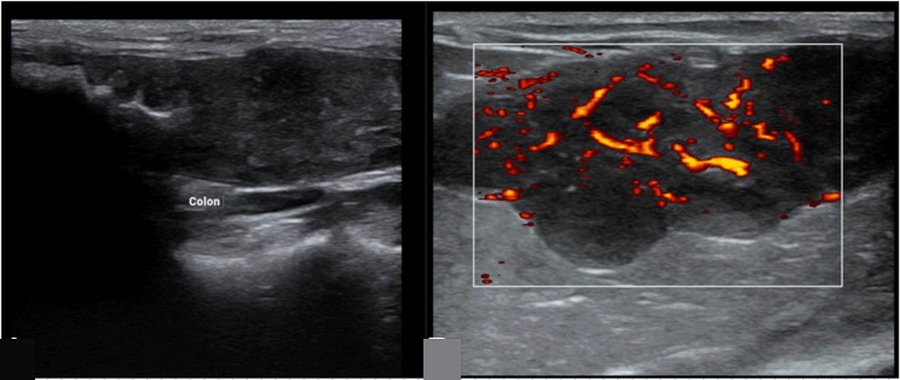
6-month-old Scottish Fold with vomiting, constipation, weight loss and jaundice. Ultrasound of the distal descending colon (left, B-mode; right, Doppler):
 zoom_inEnlarge
The wall measures 5–7 mm, has lost its layering and narrows the lumen. Which statement is most appropriate?
chevron_right Show answer and explanation
A. Loss of layering confirms adenocarcinoma: wide colectomy
Loss of layering indicates an infiltrative process but is not specific: inflammatory and granulomatous lesions look the same. Adenocarcinoma is also very rare in a 6-month-old cat.
B. It is the normal appearance of a contracted colon in such a young cat
The normal feline colonic wall is thin (around 1.5 mm) with visible layers; 5–7 mm without layering and with stenosis is clearly abnormal.
C. Consider focal FIP in a young cat and confirm with histology
Correct. In a young cat, a focal transmural thickening of the colon or ileocaecocolic junction means focal intestinal feline infectious peritonitis must be included, together with eosinophilic sclerosing fibroplasia and neoplasia. Imaging cannot tell them apart: histopathology is needed, with coronavirus immunohistochemistry if FIP is suspected.
D. Idiopathic megacolon: laxatives and prokinetics without further tests
Megacolon is a faeces-filled dilated colon with a thin wall. Here there is wall thickening with stenosis, a mechanical cause that will not respond to laxatives.
lightbulb Key takeaway
Loss of layering in the bowel wall indicates an infiltrative process, not necessarily a neoplastic one. In young cats think of focal intestinal FIP (colon, ileocaecocolic junction) and look for other signs such as lymphadenomegaly, effusions or uveitis; confirmation is histological.
Test yourself with 10 random questions
Diagnostic imaging · 200 questions, a different test every time
Related questions
Updated: November 1, 2026 · Educational content for veterinary professionals. It does not replace current clinical guidelines or the judgement of the attending veterinarian.