Struvite crystals in canine urine: how to interpret them
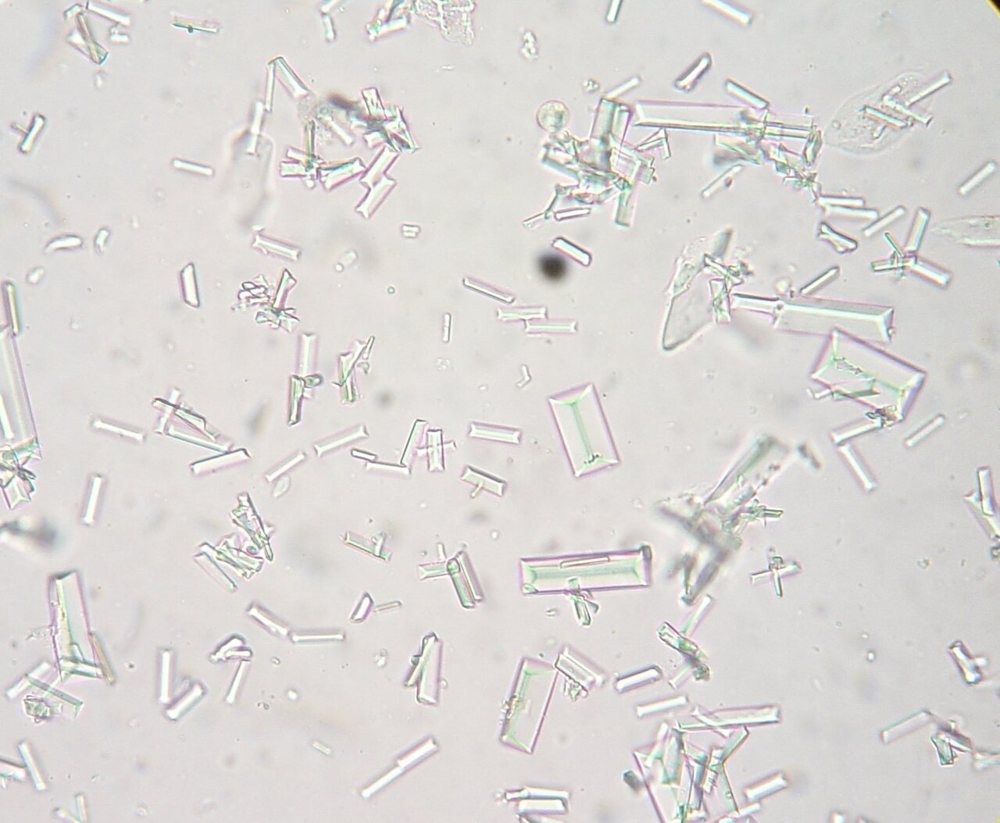
Asymptomatic 5-year-old dog at a routine check-up. Urine was collected by free catch in the morning, refrigerated and analysed 12 hours later. pH 7.5; USG 1.040; no haematuria or pyuria. The sediment shows what you see in the image.
 zoom_inEnlarge
What is the most appropriate interpretation?
chevron_right Show answer and explanation
A. It indicates struvite urolithiasis: start a dissolution diet
Crystalluria does not equal urolithiasis. Many healthy dogs have struvite crystals without forming stones; a diet is only indicated if uroliths are confirmed on imaging.
B. It is consistent with ethylene glycol toxicity
Ethylene glycol produces calcium oxalate crystals, mainly monohydrate (“picket fence” or “rice grain” shapes). The crystals in the image are “coffin-lid” struvite prisms.
C. It indicates a urinary tract infection: start empirical antibiotics
There is no pyuria, bacteriuria or clinical signs. Crystals alone do not justify antibiotics; if infection is suspected, confirm it with culture of a cystocentesis sample.
D. Likely artefact from storage and refrigeration: repeat with fresh urine analysed within 60 minutes
Correct. These are struvite crystals (“coffin-lid” prisms). Refrigeration and time make crystals precipitate in vitro, especially in concentrated, alkaline urine, with no clinical significance.
lightbulb Key takeaway
Analyse urine within 60 minutes, at room temperature. In dogs, struvite uroliths are usually associated with urease-producing bacterial infections (Staphylococcus, Proteus); in cats they are usually sterile.
Test yourself with 10 random questions
Clinical pathology · 100 questions, a different test every time
Related questions
Updated: October 31, 2026 · Educational content for veterinary professionals. It does not replace current clinical guidelines or the judgement of the attending veterinarian.