Microfilariae on a canine blood smear: next step
5-year-old dog living in the Canary Islands, with no parasite prevention and an occasional cough. The blood smear (Giemsa stain) shows what you see in the image.
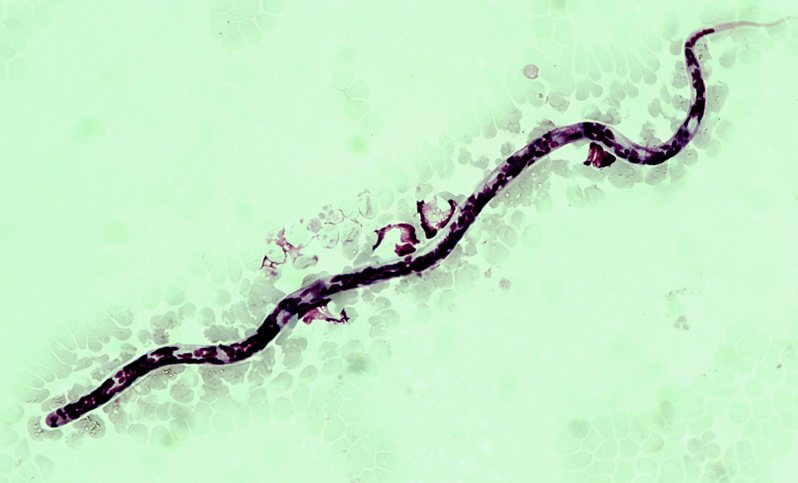 zoom_inEnlarge
What is the most appropriate next step?
chevron_right Show answer and explanation
A. Start melarsomine immediately: heartworm disease is already confirmed
The microfilaria could belong to another species (Acanthocheilonema reconditum, Dirofilaria repens), and adulticide treatment requires staging the patient and a prior protocol with doxycycline and a macrocyclic lactone.
B. Confirm with a Dirofilaria immitis antigen test and identify the microfilaria species (Knott test)
Correct. This is a microfilaria. The antigen test detects adult female D. immitis, and the modified Knott test differentiates species by morphology and size. Then: thoracic radiographs and staging.
C. Give high-dose ivermectin to clear the microfilariae as soon as possible
With high microfilaraemia, rapid larval death can cause severe reactions, and high doses are dangerous in breeds with the MDR1 (ABCB1) mutation. Confirm and stage first.
D. Nothing else is needed if the dog is stable
Heartworm disease is progressive and can cause pulmonary hypertension, right-sided heart failure and caval syndrome. The dog is also a reservoir for other animals and for people.
lightbulb Key takeaway
A smear without microfilariae does not rule out heartworm: up to 20–30% of infections are “occult”. In Spain it is endemic in the Canary Islands, Huelva, the Ebro delta and much of the Mediterranean coast. Test for antigen yearly in risk areas.
Test yourself with 10 random questions
Clinical pathology · 100 questions, a different test every time
Related questions
Updated: October 31, 2026 · Educational content for veterinary professionals. It does not replace current clinical guidelines or the judgement of the attending veterinarian.