Feline eosinophilic plaque: diagnosis and treatment
4-year-old female cat with intensely pruritic lesions on the ventral abdomen and inner thighs that she licks constantly. Impression cytology shows numerous eosinophils.
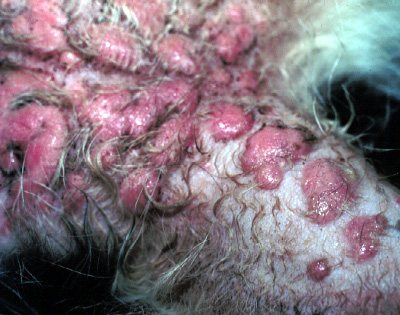 zoom_inEnlarge
What is the diagnosis and the correct approach?
chevron_right Show answer and explanation
A. Squamous cell carcinoma; surgical excision
Squamous cell carcinoma appears on sun-exposed, depigmented areas (ears, nasal planum, eyelids) of white cats, and cytology would show atypical epithelial cells, not eosinophils.
B. Eosinophilic plaque; find and control the underlying hypersensitivity (flea, food or environmental)
Correct. Raised, eroded, very pruritic plaques on the abdomen and thighs with eosinophils on cytology: this is an eosinophilic plaque, part of the feline eosinophilic granuloma complex. There is almost always an underlying allergy: strict flea control, an elimination diet and assessment for atopy.
C. Dermatophytosis; fungal culture and itraconazole
Dermatophytosis causes alopecia and scaling, usually with little pruritus, and cytology would not show numerous eosinophils.
D. Indolent ulcer, whose typical location is the abdomen
The indolent ulcer also belongs to the eosinophilic granuloma complex, but it appears on the upper lip and is not usually pruritic.
lightbulb Key takeaway
Eosinophilic plaques are often infected: check cytology for bacteria and use antibiotics if there is secondary infection. For symptom control: corticosteroids, ciclosporin or oclacitinib. Without controlling the underlying allergy, they recur.
Test yourself with 10 random questions
Dermatology · 100 questions, a different test every time
Related questions
Updated: October 31, 2026 · Educational content for veterinary professionals. It does not replace current clinical guidelines or the judgement of the attending veterinarian.