Ureteral obstruction in cats: pyelectasia and ureteroliths
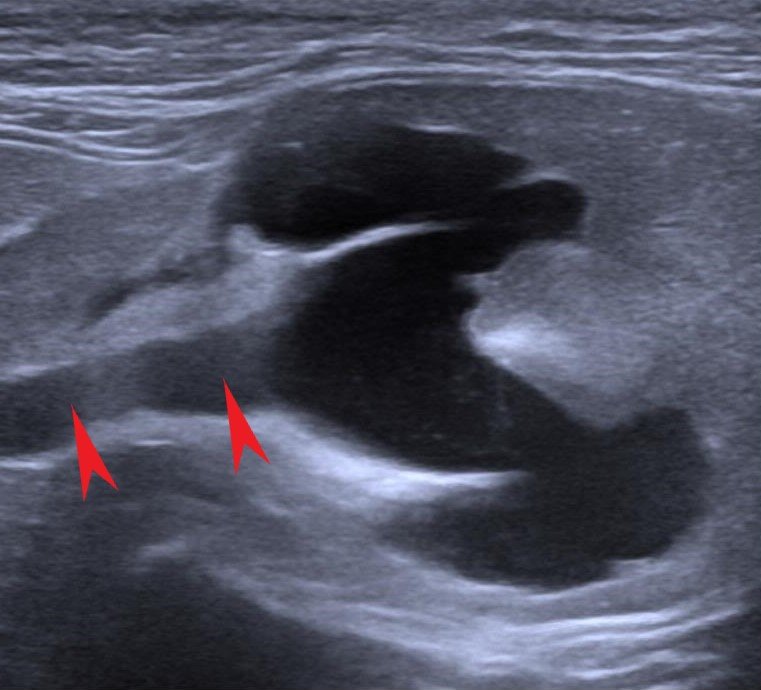
8-year-old British Shorthair with vomiting, anorexia and creatinine of 7.2 mg/dL (ref. 0.8–2.0). On palpation, one kidney is large and painful and the other small and irregular. There is no urethral obstruction. Ultrasound of the large kidney; the arrowheads mark the proximal ureter:
 zoom_inEnlarge
What is most appropriate given this image?
chevron_right Show answer and explanation
A. Attribute it to fluid therapy and repeat the ultrasound in a month
Fluid therapy and diuresis cause mild pyelectasia of a few millimetres, without a dilated ureter. A pelvis this dilated with a distended ureter and severe azotaemia indicates obstruction and cannot wait.
B. Follow the ureter to the cause of the obstruction and add radiographs
Correct. Marked pyelectasia with a dilated proximal ureter indicates ureteral obstruction. Follow the ureter to the cause (almost always calcium oxalate ureteroliths with acoustic shadowing, or a stricture) and take radiographs to count the stones. It is an emergency: stabilise and consider decompression.
C. Treat it as pyelonephritis, with antibiotics alone and no further imaging
Pyelonephritis can dilate the pelvis, but with this degree of dilation and a distended ureter, obstruction must be ruled out first. If both are present, antibiotics alone are not enough.
D. Perform intravenous excretory urography as the next step
With creatinine at 7.2 mg/dL, filtration is so low that contrast is barely excreted and the study is not diagnostic; iodinated contrast also adds risk. Ultrasound and radiography (or antegrade pyelography) are more useful.
lightbulb Key takeaway
"Big kidney–little kidney" syndrome: the large kidney is usually obstructed and the small one already had chronic disease. Calcium oxalate ureteroliths do not dissolve: stabilise and consider decompression (subcutaneous ureteral bypass or stent) at an experienced centre. Combine ultrasound and radiography so small stones are not missed.
Test yourself with 10 random questions
Diagnostic imaging · 200 questions, a different test every time
Related questions
Updated: October 31, 2026 · Educational content for veterinary professionals. It does not replace current clinical guidelines or the judgement of the attending veterinarian.