Radiation protection in veterinary practice: ALARA and restraint
A nervous cat needs skull radiographs. The owner offers to hold it, and a pregnant veterinary nurse suggests doing it herself with a lead apron and gloves. Lateral and dorsoventral views to be obtained:
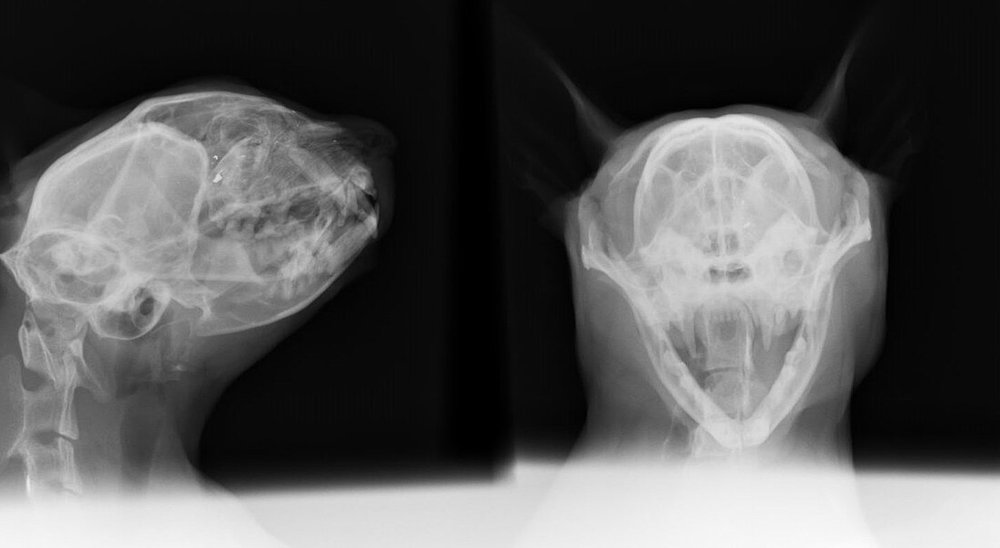 zoom_inEnlarge
Which approach follows the principles of radiation protection?
chevron_right Show answer and explanation
A. Let the nurse hold it, because lead gloves protect even if the hands are in the primary beam
Lead gloves and aprons protect against scatter, not the primary beam. Moreover, pregnant workers must not restrain animals during exposure.
B. Let the owner hold it wearing a personal dosimeter, since the dosimeter protects them
The dosimeter only measures the dose received; it does not protect. Restraint by the owner is not standard practice and could only be justified exceptionally.
C. Sedate the cat and position it with wedges, sandbags and tapes; if restraint is exceptionally needed, use trained, non-pregnant staff with protection and outside the primary beam
Correct. The ALARA principle (doses as low as reasonably achievable) prioritises sedation and positioning aids. Manual restraint is used only when justified, with apron, gloves and thyroid shield, at maximum distance and never with any body part in the primary beam.
D. It does not matter who holds it as long as they wear an apron: distance from the tube hardly affects dose
Distance is one of the most effective measures: intensity decreases with the square of distance (at twice the distance, a quarter of the dose).
lightbulb Key takeaway
Protection = justification, optimisation (ALARA) and dose limitation, with three tools: time, distance and shielding. Always collimate. In Spain, an X-ray installation must be entered in the official register, undergo periodic quality and radiation-level checks, and those who direct or operate it need accreditation from the Nuclear Safety Council (CSN); exposed workers wear a personal dosimeter.
Test yourself with 10 random questions
Diagnostic imaging · 200 questions, a different test every time
Related questions
Updated: October 31, 2026 · Educational content for veterinary professionals. It does not replace current clinical guidelines or the judgement of the attending veterinarian.