Renal resistive index on pulsed-wave Doppler in the cat
13-year-old domestic shorthair cat with chronic kidney disease. Pulsed-wave Doppler of an intrarenal artery; the machine measures a peak velocity of 32 cm/s, a minimum velocity of 7.15 cm/s and a resistive index (RI) of 0.776:
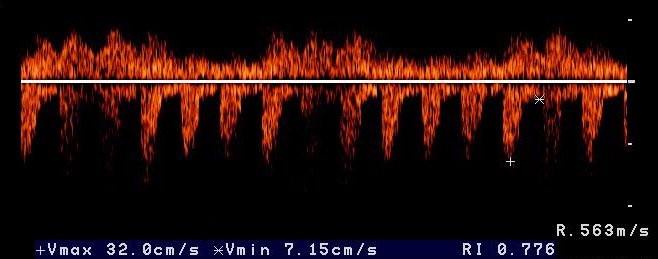 zoom_inEnlarge
Which statement about this resistive index is correct?
chevron_right Show answer and explanation
A. It is normal: in dogs and cats the renal RI goes up to 0.90
The accepted upper limit in healthy dogs and cats is around 0.70. A value of 0.78 is above it.
B. It definitely indicates ureteral obstruction and requires a bypass
Obstruction can raise the RI, but so can CKD, acute kidney injury and non-renal factors. Obstruction is diagnosed from a dilated pelvis and ureter and their cause.
C. It is calculated as Vmin/Vmax and is not affected by heart rate
The formula is (Vmax − Vmin)/Vmax = (32 − 7.15)/32 ≈ 0.78. Heart rate, blood pressure, sedation and dehydration all change the value.
D. It exceeds the usual limit (~0.70) and reflects higher intrarenal resistance, but it is non-specific
Correct. RI = (Vmax − Vmin)/Vmax. A raised RI indicates increased intrarenal vascular resistance and occurs in CKD, acute kidney injury or obstruction; it does not identify the cause and is interpreted alongside the clinical picture, laboratory results and B-mode imaging.
lightbulb Key takeaway
Measure the RI in interlobar or arcuate arteries, at several sites in both kidneys with the animal calm, and average the values. Take heart rate and blood pressure into account when interpreting it: it is a complementary finding, not a diagnosis.
Test yourself with 10 random questions
Diagnostic imaging · 200 questions, a different test every time
Related questions
Updated: October 31, 2026 · Educational content for veterinary professionals. It does not replace current clinical guidelines or the judgement of the attending veterinarian.