Immune-mediated polyarthritis, septic arthritis and OA on imaging
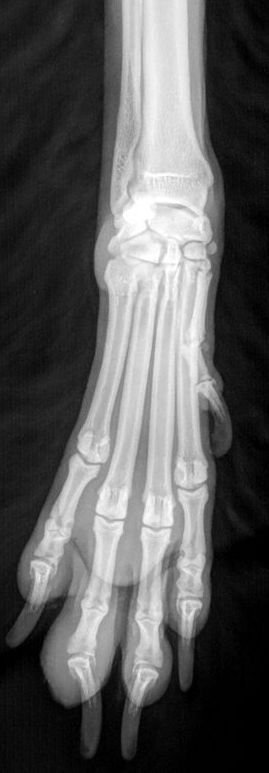
4-year-old Pointer with fever, lethargy and shifting lameness. Both carpi and tarsi are swollen and painful. Radiographs show effusion and periarticular soft-tissue swelling in the carpi and tarsi, with no osteophytes, subchondral lysis or periosteal reaction. Dorsopalmar radiograph of the right carpus and forepaw:
 zoom_inEnlarge
What is the most appropriate interpretation and next step?
chevron_right Show answer and explanation
A. Septic arthritis: empirical antibiotics without further tests
Septic arthritis is usually monoarticular and, over time, causes subchondral lysis and periosteal reaction. A symmetrical polyarticular picture without bone lesions fits poorly, and it should not be treated without arthrocentesis and culture.
B. Osteoarthritis: NSAIDs and weight control
Osteoarthritis causes osteophytes, enthesophytes and subchondral sclerosis, and does not cause fever. The absence of bony changes and the systemic illness rule it out as the explanation.
C. Erosive polyarthritis: the pattern confirms the rheumatoid form
The erosive form shows punched-out subchondral erosions, joint space narrowing and sometimes collapse or subluxation. Here there are no bone lesions.
D. Non-erosive polyarthritis: arthrocentesis of several joints and search for infectious causes
Correct. Symmetrical polyarticular effusion in distal joints without bony changes is the pattern of non-erosive polyarthritis, the most common immune-mediated form. Confirm it with arthrocentesis (non-degenerate neutrophils) and rule out causes such as leishmaniosis or ehrlichiosis before immunosuppression.
lightbulb Key takeaway
Radiographs classify the pattern (pure effusion, erosion, proliferation, lysis), but any inflammatory arthritis is diagnosed cytologically. In Spain, always test for leishmaniosis and vector-borne diseases in a polyarthritis. In a monoarthritis with subchondral lysis, think of infection and culture the synovial fluid.
Test yourself with 10 random questions
Diagnostic imaging · 200 questions, a different test every time
Related questions
Updated: October 31, 2026 · Educational content for veterinary professionals. It does not replace current clinical guidelines or the judgement of the attending veterinarian.