Polycystic kidney disease in Persian cats: ultrasound diagnosis
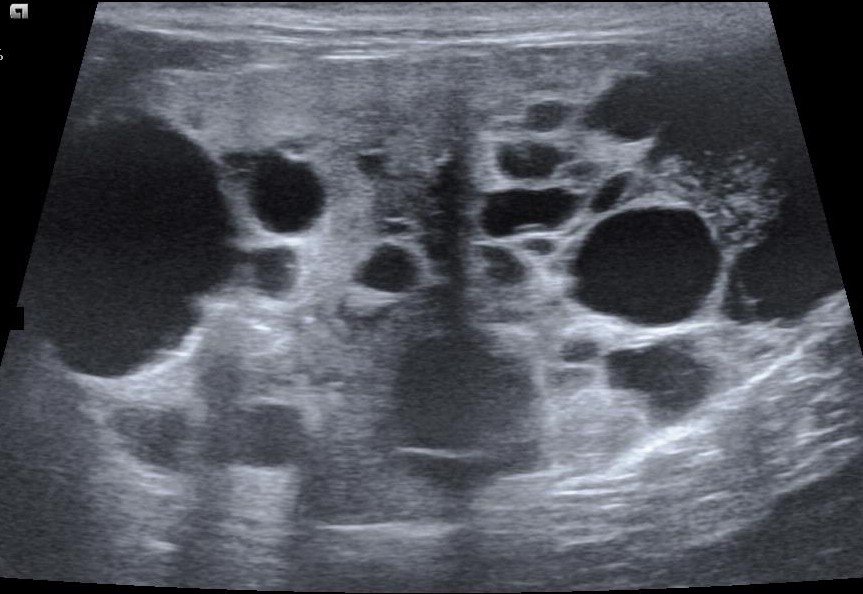
18-month-old male Persian cat with no clinical signs, at a pre-breeding check. Both kidneys contain multiple round, anechoic, thin-walled structures with posterior acoustic enhancement in the cortex and medulla. Transverse section of one kidney:
 zoom_inEnlarge
Which statement is correct?
chevron_right Show answer and explanation
A. It is an autosomal dominant disease; relatives should be screened (PKD1 genetic test or ultrasound) and affected cats should not be bred
Correct. PKD in Persians and related breeds is caused by a dominant mutation in the PKD1 gene: a single allele is enough to have the disease. The genetic test detects that mutation at any age; ultrasound is reliable from about 10 months of age.
B. It is autosomal recessive, so healthy carriers can be bred together without risk
Inheritance is dominant: there are no healthy carriers, any cat with the mutation develops cysts, and half of its offspring will inherit it.
C. The treatment of choice is ultrasound-guided drainage of the cysts
Draining cysts does not slow the disease: cysts are multiple and refill. Treatment is that of chronic kidney disease according to IRIS stage.
D. It is the same disease as perirenal pseudocysts
Perirenal pseudocysts are fluid accumulations between the capsule and the parenchyma, without epithelium, surrounding the kidney. They are a different entity from the intraparenchymal cysts of PKD.
lightbulb Key takeaway
A simple cyst on ultrasound: anechoic, round, thin-walled and with distal acoustic enhancement. PKD can also affect the liver and its progression is variable: many cats do not develop CKD until middle or old age. For breeding, the PKD1 genetic test allows selection of clear breeding cats before ultrasound becomes reliable.
Test yourself with 10 random questions
Diagnostic imaging · 200 questions, a different test every time
Related questions
Updated: October 31, 2026 · Educational content for veterinary professionals. It does not replace current clinical guidelines or the judgement of the attending veterinarian.